
Joined Incisions Mastectomy

An option for scar placement

Medically reviewed by: Dr. med. Timo Spanholtz

Top Surgery for trans* men (gender-affirming chest masculinization) is not only about breast removal and contouring, but also about the way the surgical incisions are made. An important aspect here is the decision of whether the two lateral incisions should be connected (joined) or not. This decision influences the scar course, aesthetic result, and skin tension in the central chest area.

What does "Joining Incisions" mean?

"Joining Incisions" describes a technique in which the two lateral incision lines – typically in a Double Incision Top Surgery – do not remain as two separate horizontal scars, but are connected in the middle of the chest, resulting in a continuous scar.

Depending on the anatomical starting point, desired aesthetic result, and skin condition, a surgeon may recommend connecting the incisions or deliberately leaving them separate. Both variants have advantages and disadvantages, which are considered together during the consultation.


What are the alternatives?

If the incisions are not connected, two separate scars result, one on each side of the chest. This solution can be useful for some individuals, particularly when:

  • the skin quality allows for managing without excess skin in the center
  • a less continuous scar is preferred
  • other individual anatomical characteristics need to be taken into account

If "Dog Ears" should still appear later, a small revision can be corrected through a further, targeted procedure.

When is connecting the incisions recommended?

A surgeon may recommend connecting the incisions when:

  • the anatomy requires it in order to safely remove excess skin
  • you prefer an even horizontal scar
  • a very smooth and flat chest profile is desired

Often the differences between the variants are best recognized during a personal consultation, since individual factors such as skin tension, breast size, and desired result play a role here.


Appearance & Scar Course – What can I expect?

Whether with connected or separate incisions – scars are a natural part of any surgical procedure. They vary from individual to individual and often become less visible and softer in appearance during the course of healing.

With professional scar care, sun protection, and regular follow-up appointments, the long-term course can be positively influenced.
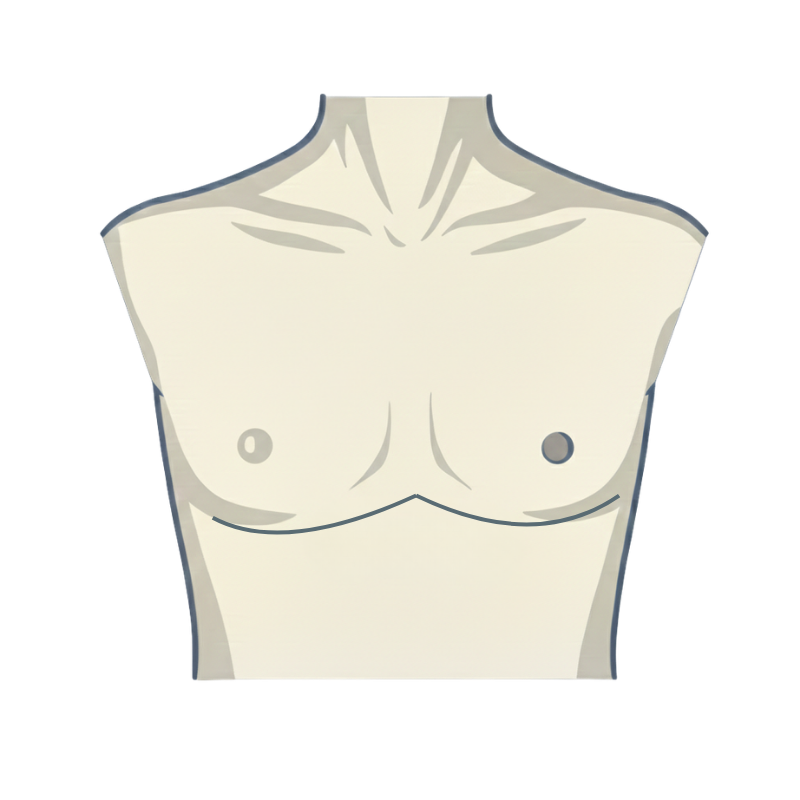
Joining Incisions

(Image generated by AI)

Why do surgeons connect the incisions?

Surgeons often connect incisions for two reasons:

Minimizing excess skin ("Dog Ears")

If the incisions are not connected, excess skin can remain in the central chest area, which can later be perceived as small "bulges" or "Dog Ears". By connecting the incisions, this skin is removed without wrinkles, which leads to a smoother, more even chest profile.

A harmonious, continuous scar appearance

A connected incision creates a scar that runs evenly across the chest. This can appear more cohesive in appearance and allows the surgeon to specifically tighten and contour the skin.

It is important to know: A continuous scar is not "better" or "worse" per se – rather, it is one of several valid variants that can be useful depending on body type and personal preference.

Shared decision-making during the consultation

The decision of whether or not to connect incisions should always be made together with the surgical team. The following are taken into account in the preliminary discussion:

  • Your body shape and skin condition
  • the desired aesthetic result
  • possible scar preferences
  • Your personal priorities for healing and result

This results in a surgical plan tailored to you that takes your goals into account in the best possible way.

An informed choice for your result

"Joining Incisions" is a useful option in trans* men Top Surgery for removing excess skin and creating an even scar appearance across the chest. Whether this technique is suitable for you depends on your individual anatomy and your personal goals. An open, detailed consultation ensures that you can make an informed decision that fits your desired result.

Frequently asked questions about Joined Incisions Mastectomy

We are happy to answer your questions about the treatment here.

Will I experience more pain or a longer healing time with the Joined Incisions Mastectomy?

No, the healing time and the sensation of pain with the Joined Incisions Mastectomy do not differ from the classic Double Incision with separate scars. Wound healing in the middle area of the chest is usually unproblematic, as there is less movement here than in the armpit area, for example.

Can I also opt against joined incisions in the Joined Incisions Mastectomy?

The choice of incision technique is always an individual decision that is made during the consultation. If your anatomy allows it (sufficient skin elasticity, less excess tissue in the center), the incisions can also remain separate. We will advise you honestly on which option promises the best medical and aesthetic result for your body.

Will the health insurance cover the costs for a Joined Incisions Mastectomy?

Yes, provided that there is a cost approval for a mastectomy (gender-affirming surgery), the specific incision technique (whether separate or joined) is part of the surgical procedure. The choice of technique is at the discretion of the surgeon in consultation with you, in order to achieve the best possible medical outcome.

Does the Joined Incisions technique prevent so-called "Dog Ears"?

Yes, this is one of the main reasons for this method. "Dog Ears" are small excesses of skin that can often form at the end or in the middle of scars. The continuous incision allows the skin tension to be distributed optimally, which significantly minimizes the risk of tissue protrusions (particularly in the sternum area).

When is a joined incision technique (Joined Incisions) advisable?

This technique is usually recommended when there is a lot of excess skin tissue or when skin elasticity is low. By joining the incisions in the middle, the surgeon can more precisely remove excess skin in the center. This prevents the formation of skin folds between the pectoral muscles and ensures a flatter overall result.

What exactly is a Joined Incisions Mastectomy?

In a Joined Incisions Mastectomy (also called "connected incision technique"), the two horizontal incisions of a Double-Incision surgery are connected to each other in the middle of the chest. Instead of two separate scars, this creates one continuous, usually flat scar across the chest. This technique is used to achieve a particularly smooth and masculine chest profile.

What does the scar look like after a Joined Incisions Mastectomy?

After healing, a fine, horizontal line runs across the entire chest. Initially, this is reddish, but with good scar care it fades to a light, flat line within 12 to 18 months. Many patients find the continuous symmetry of the scar to be more aesthetically harmonious than two separate, possibly asymmetrical scars.

Schedule an appointment

Get a no-obligation consultation about Joined Incisions Mastectomy now. We clarify all open questions and talk about your desired change.

Completely without pressure, completely non-binding, and above all at eye level and without prejudice!